Which Trees Do Charleston, Beaufort and Dorchester Counties Protect?
In unincorporated Charleston County, a grand tree is any tree 24 inches DBH or more, except pine and sweet gum. Beaufort County protects specimen trees starting at 4 inches for dogwood, redbud and southern magnolia. Dorchester County protects trees other than pines from 15 inches, and pines from 24 inches.
DBH means diameter at breast height, and Charleston County measures it 4.5 feet above the ground. This is general information, not legal advice. The owner and the county decide permits, tree surveys and any tree removal. Towns inside these counties have their own tree ordinances.
How do the county tree rules compare?
Each county sorts trees into classes by species and trunk size. Once a future homesite has the permits it needs, our lot clearing takes out the brush around these trees.
| County | Tree class | Size (DBH) | What brings in a permit or survey |
|---|---|---|---|
| Charleston | Grand tree | 24 inches and up, except pine and sweet gum | Grand Tree Removal Permit to remove one; Zoning Permit for heavy pruning |
| Charleston | Protected tree | 8 inches and up for non-single-family uses; 6 inches in a Scenic Road right-of-way; every tree in a required buffer | Zoning Permit before clearing land for development |
| Beaufort | Specimen tree | Dogwood, redbud and southern magnolia at 4 inches; listed overstory trees such as live oak at 16 inches; all others at 24 inches, invasives excepted | Tree survey before development approval, covering every tree 8 inches and up; bona fide forestry excepted |
| Beaufort | Grand tree on a single-family lot | Live oak, black walnut and longleaf pine at 24 inches; loblolly, slash and shortleaf pine at 36 inches; other trees at 30 inches | Tree removal permit to remove one from a lot with a home |
| Dorchester | Protected tree | 15 to 24 inches, pines excluded | Zoning definitions prohibit removal or abuse; the county has a tree removal permit application |
| Dorchester | Grand tree | 24 inches and up, pines included | Same as protected trees; clearing a wooded lot may need a land disturbance permit |
What does the Charleston County tree ordinance protect?
Article 9.2 of the county’s zoning rules covers tree protection and preservation. It applies to all real property in unincorporated Charleston County, unless the land is expressly exempted. Its top class is the grand tree: 24 inches DBH or more, except pine and sweet gum.
Smaller trees count too. The county’s tree ordinance brochure says all trees 8 inches or greater are protected for non-single-family residential uses. The county’s tree removal application defines protected trees to include every tree in a required buffer or landscape area. In a Scenic Road right-of-way, trees count from 6 inches.
When does Charleston County require a tree permit?
Before clearing land for development, the brochure says to get a Zoning Permit from the Zoning and Planning Department. No grand tree comes out without a Grand Tree Removal Permit. That permit may be approved when the tree is dead, diseased, dying or a hazard. Otherwise, the Board of Zoning Appeals may approve removal in the case of a hardship.
Pruning has a limit too. On a grand tree, removing 3 or more limbs of 6 inches or more each takes a Zoning Permit. So does pruning more than 25 percent of the leaf surface.
On the county’s residential tree affidavit, the owner certifies the work will not disturb grand or protected trees. Violations can bring stop work orders, revoked zoning and building permits, certificate of occupancy delays, fines and tree replacement.
What does Beaufort County protect, and when is a tree survey due?
Beaufort County’s Community Development Code protects specimen trees. Dogwood, redbud and southern magnolia qualify at 4 inches DBH. Listed overstory trees qualify at 16 inches, including live oak, bald cypress, American holly, hickory, pecan and palmetto. Every other tree qualifies at 24 inches, except invasive species such as Chinese tallow, the popcorn tree.
Before any development approval, the applicant provides a tree survey of the areas to be built, cleared or constructed. Bona fide forestry is exempt from that step. The survey covers every tree 8 inches DBH and larger, plus dogwoods, redbuds and magnolias from 4 inches. A certified arborist, professional urban forester, registered landscape architect or registered land surveyor does the survey.
If trees come down before a development has its county permits, the county withholds the development permit for two years. Mitigation planting for the removed trees is the exception.
The county’s code enforcement FAQ says a permit is often needed to remove a tree in unincorporated Beaufort County. The rules differ for developed and undeveloped land, and for residential and other property.
What do Dorchester County’s tree rules cover?
Dorchester County’s zoning ordinance definitions set two classes. A protected tree is 15 to 24 inches DBH, excluding pines. A grand tree is 24 inches DBH or greater, including pines. The same definitions say the removal, relocation, destruction or abuse of any protected or grand tree is prohibited.
For a tree that has to come out, the county uses a tree removal permit application. If the applicant does not own the land, the owner must give written permission. The form says to mark the trees with paint or ribbon.
The form also notes that clearing a vacant or wooded lot that disturbs soil may need a land disturbance permit. A county tree removal permit does not replace any approval your homeowners association requires. Our land clearing permit guide covers the stormwater and coastal permits.
Do single-family lots, farms and forestry get different rules?
In Charleston County, single-family detached residential lots of record are exempt from the tree article, with one catch. The grand tree rules for documentation, protection and replacement still apply. Tree removal for bona fide agricultural uses is exempt on the same terms, so grand trees stay covered there too.
In Charleston County, tree removal for bona fide forestry operations has to comply with state law. In Beaufort County, forestry on parcels over 5 acres must come with a Forestry Management Plan. A registered South Carolina forester approves that plan.
Clear cutting, in Beaufort County’s code, means clearing more than 25 percent of a parcel. After a clear cut under a forestry claim, any development permit application on the property waits one year. With no Forestry Management Plan, the wait is five years, and mitigation planting is required.
On a Beaufort single-family lot, the age of the house matters. With a home under five years old, specimen, grand and mitigation trees need a tree removal permit. Once the home is five or more years old, the list drops to grand and mitigation trees. Other trees on a lot with a home need no permit, unless they stand in a river buffer.
How does clearing work around protected trees?
Each county’s rules describe a barrier for trees that stay. Charleston County’s affidavit calls for tree protective barricades around all required trees. Dorchester County’s definitions call for highly visible barricades at least 3 feet high.
On a Beaufort County development site, four-foot tree protection fences go up around preserved trees before site work starts. The Director or a designee approves them before clearing and grading begin. The fences keep people, equipment and vehicles out.
For a tree standing alone, Beaufort’s protection zone is a radius of one foot for every inch of DBH. A 24-inch live oak gets a 24-foot radius.
Beaufort County also limits underbrushing. Inside a forest preservation area, the Director may allow selective underbrushing, depending on the approved use of the area. Underbrushing is not allowed in the River Buffer.
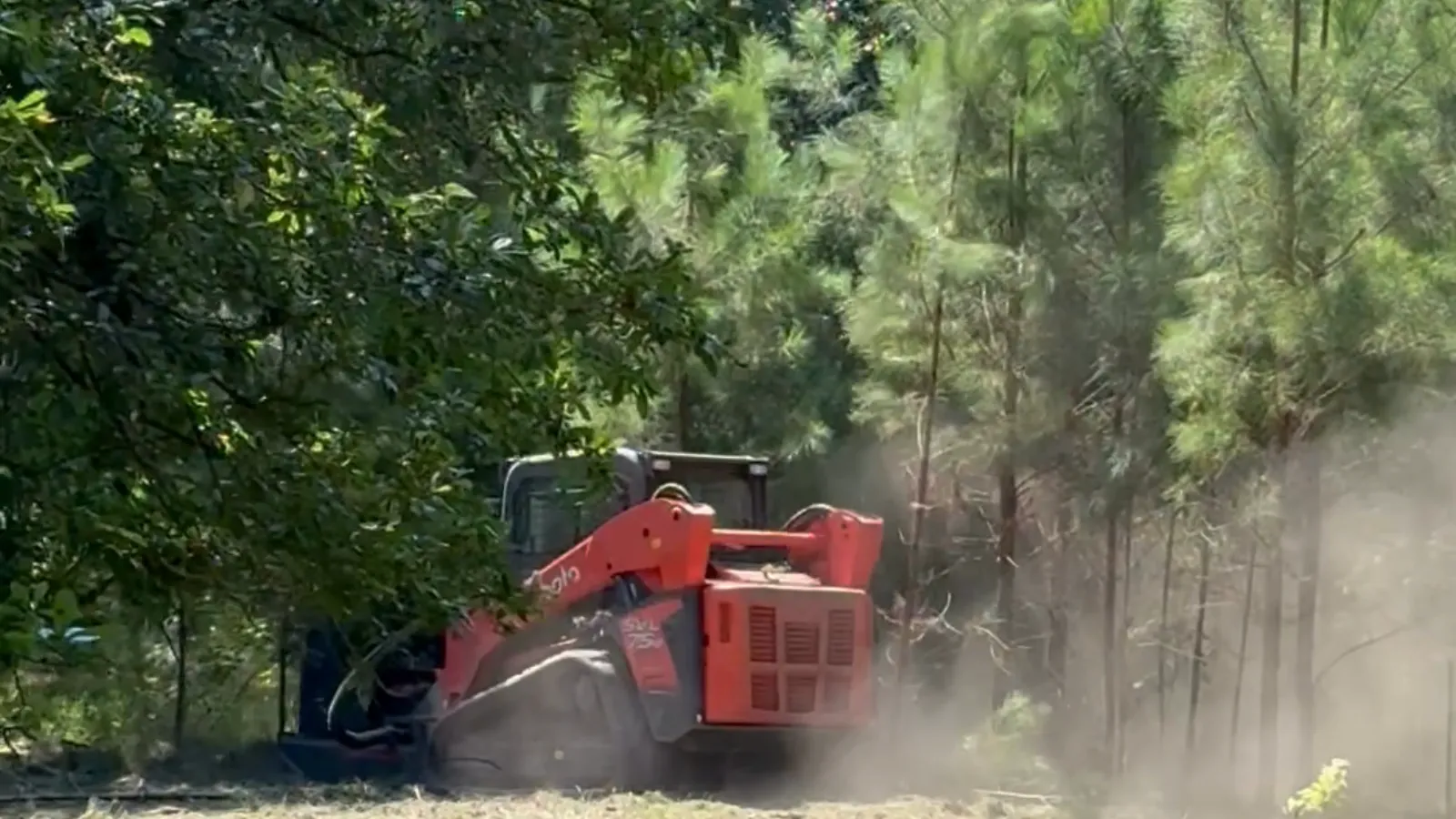
We clear brush, vines and understory around the trees these rules protect and mulch it in place. Our Kubota SVL compact track loader carries a forestry mulching head, and the trees you keep stay standing. Where fences or barricades are up, the mulcher works outside them.
We never remove grand or specimen trees, and we never pull permits, do tree surveys or write arborist reports. In the woods, underbrushing and understory clearing opens the floor under the canopy, and land clearing takes back bigger overgrown ground. Our family mulches the understory on its own 327-acre tract in the ACE Basin near Yemassee every year.
Do towns follow the county tree rules?
Towns have their own tree ordinances, and they can differ from the county’s. Charleston County’s tree article covers unincorporated land, and so do Beaufort County’s resource protection standards. If your land sits inside town limits, start with the town. Our pages for Mount Pleasant, North Charleston, Hilton Head Island and Ridgeville cover each town’s tree rules.
We work across Charleston, Summerville, Walterboro, Beaufort and the rest of the Lowcountry. Call (843) 696-7162 for a free estimate.